Most Buyers Know an Acre Name—but Not What It Really Means in Size
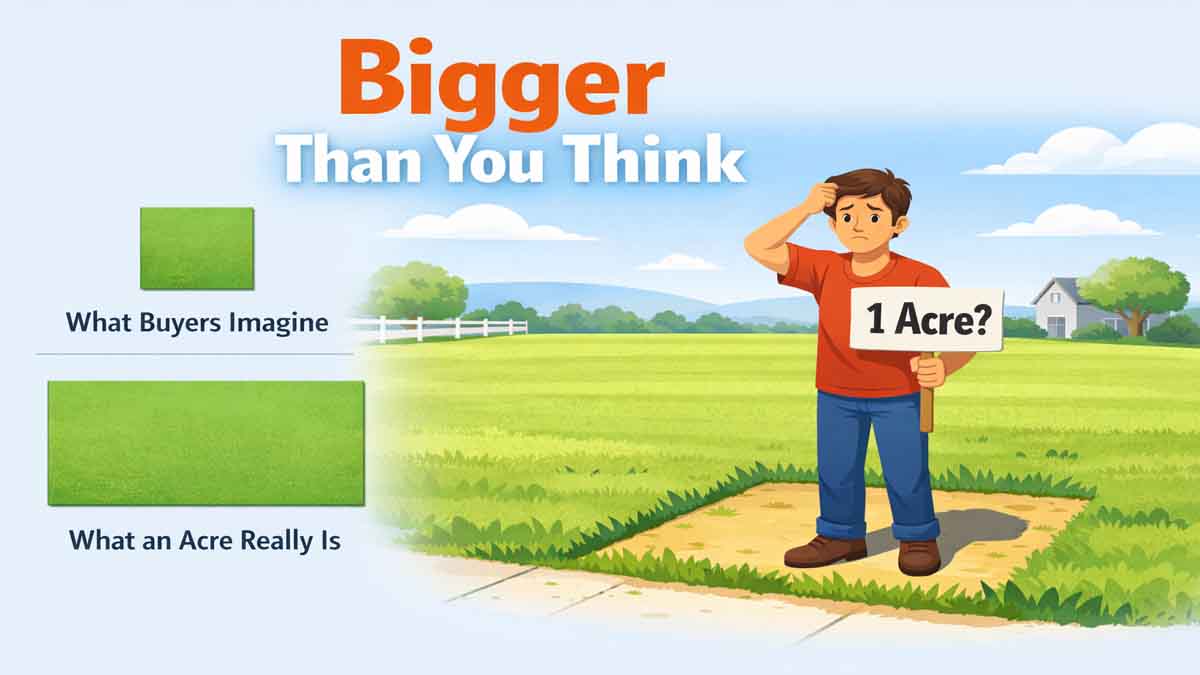
You've heard "acre" a hundred times in property listings. But can you picture it? Most American buyers can't visualize what they're actually buying. This confusion leads to wrong expectations and costly mistakes. Let's fix that. We'll break down acre size into terms you can actually understand—starting with what matters for your next property purchase in 2026.
When you see "5-acre property" in a listing, what comes to mind? For most US buyers, it's just a number. But that number represents your future backyard, your investment, your space. Understanding acre size isn't about math—it's about envisioning your life on that land. In 2026's competitive market, this knowledge separates smart buyers from disappointed ones. Let's transform that abstract term into something tangible you can use today.
The acre has been America's land measurement standard since colonial times, yet it remains misunderstood. Developers use it, agents mention it, but few explain it in human terms. That ends now. We'll translate acre measurements into real-world comparisons that make immediate sense for today's property buyer.
Why "Acre" Means Nothing Without Context
You're not alone if "acre" feels abstract. The term entered American English centuries ago, but its practical meaning gets lost between listing descriptions and closing documents. This creates three major problems for buyers.
The Visualization Gap
Numbers don't create mental pictures. "1 acre" sounds specific, but without a reference point, your brain can't translate it. Is that a small garden or a football field? This gap causes disappointment when buyers finally visit properties.
Comparative Confusion
Without benchmarks, comparing properties becomes guesswork. Is 2 acres twice as big as 1 acre in practical terms? Not necessarily—shape matters. Irregular lots can have the same acreage but feel completely different.
Value Misalignment
Price per acre varies wildly across the US. In Wyoming, $2,000 per acre might get you usable land. In suburban New York, that same acre costs $500,000. Without size understanding, you can't assess value properly.
What An Acre Actually Measures
Let's start with the technical definition, then immediately translate it into practical terms. One US survey acre equals exactly 43,560 square feet. But that's still abstract. Let's break it down visually.
| Visual Comparison | How Many Fit in 1 Acre | Practical Takeaway |
|---|---|---|
| Football Fields (without end zones) | About 0.76 | An acre is roughly 3/4 of a football field |
| Tennis Courts (doubles) | Approximately 15 | Think 15 tennis courts side by side |
| Average US House (2,500 sq ft) | About 17 houses | Land for 17 average homes |
| Basketball Courts (NBA size) | Nearly 10 | 10 full basketball courts fit comfortably |
| Parking Spaces (standard) | About 150 spaces | A substantial parking lot |
The key insight? An acre isn't just area—it's potential. That 43,560 square feet could be a long narrow strip or a perfect square measuring 208.7 feet per side. Shape transforms how land feels and functions.
Expert Tip: The "Walk Test"
Here's my field-tested method: When viewing property, pace it out. Normal walking stride is about 2.5 feet. Walk 84 steps in one direction, turn 90 degrees, walk another 84 steps. You've just traced roughly one side of a square acre. Do this twice to visualize the full acre. This simple test prevents the "it looked bigger online" disappointment.
How Acre Misunderstanding Costs Buyers
Let me share a 2025 case from my consulting files (details anonymized). A couple sought a "2-acre property for gardening and space." They found a listing with beautiful photos and purchased sight-unseen during the pandemic boom.
The Reality Shock
Upon arrival, they discovered steep terrain made 40% unusable. The "2 acres" felt like half that. Their dream garden required $25,000 in terracing. They'd confused total acreage with usable acreage—a common $50,000+ mistake.
The Professional Assessment
When I surveyed the property, only 1.2 acres were buildable/garden-ready. The listing wasn't false—it was incomplete. This happens daily across US markets. Buyers see acre numbers but not land reality.
The Solution Framework
Now I advise clients: "Acreage times usability factor equals functional land." Ask: What percentage is flat? How much is restricted? Is there easement or wetland? These questions matter more than the raw acre number.
Why Shape Matters More Than Acreage
Two properties with identical acreage can serve completely different purposes. A 1-acre square (208.7×208.7 feet) feels spacious and functional. A 1-acre strip (43,560×1 foot) is useless for most purposes.
The Buildability Index
Local zoning dictates minimum lot dimensions. In many US counties, you need 150 feet of road frontage per acre. That narrow 1-acre lot might not be buildable at all, despite having "enough" acreage.
The Usability Matrix
Consider these 2026 zoning realities: For a standard US home, you typically need 100×100 feet of relatively flat land. That's about 0.23 acres just for the house footprint. Add driveway, septic, and setbacks, and 1 acre becomes 0.5 acres of usable space quickly.
2026 Tools to Visualize Acreage Accurately
Technology has solved the visualization problem. Use these free tools before your next property visit.
Satellite Overlay Method
Google Earth Pro lets you draw an acre boundary over any location. See exactly how an acre fits in your neighborhood. This 5-minute exercise prevents months of regret.
Mobile Measurement Apps
Apps like LandGlide use your phone's GPS to walk property boundaries. They calculate exact acreage and show it over satellite imagery. Essential for rural purchases.
Zoning Check Platforms
Most US counties now offer interactive zoning maps. Input an address to see exact buildable areas, setbacks, and restrictions. Never assume—always verify.