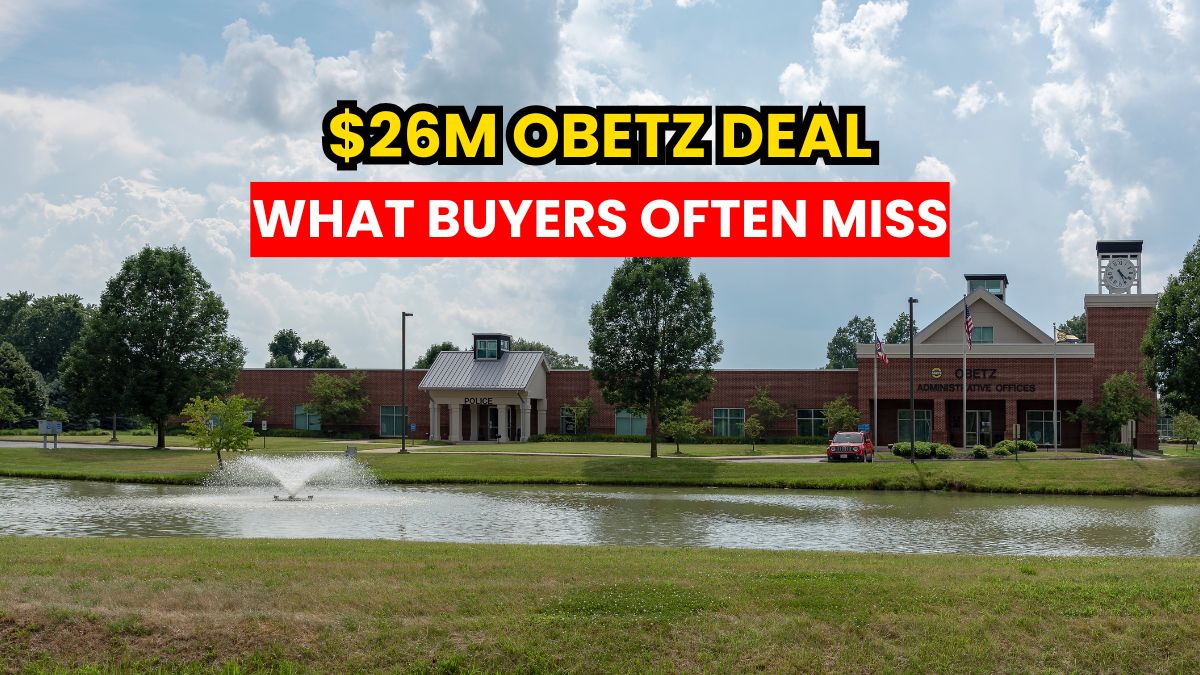
In May 2025, Aireit LLC—a subsidiary of global investment giant Ares Management—purchased a 253,764-square-foot warehouse at 2315 Creekside Parkway in Obetz, Ohio. The price: $26.7 million as part of a $54.4 million portfolio deal.
What makes this transaction extraordinary isn't the dollar amount alone. It's the 90% appreciation from its 2015 sale price of $14.2 million. Over a decade that included a global pandemic and supply chain revolutions, this property nearly doubled in value.
The $26.7 Million Signal: More Than Just a Warehouse
This transaction represents a fundamental shift in industrial real estate valuation. Traditional metrics like construction costs and acreage no longer dictate value. Instead, three modern factors dominate:
1. Logistics Velocity Over Simple Location
The property sits just 5 miles from Rickenbacker International Airport, a cargo-dedicated hub. In logistics terms, this proximity reduces "drayage costs"—the expensive short-haul transport from airport to warehouse.
Tenants pay premium rents for this advantage. Investors recognize that enduring demand and pay accordingly. The land value here correlates directly with freight volume moving through Rickenbacker.
2. The Regulatory Moat: Zoning as Value Creator
Obetz's Planned Industrial District (PID) zoning creates artificial scarcity. Strict setbacks, lot coverage caps, and aesthetic requirements limit supply while maintaining property values.
This "regulatory moat" protects investments. Institutional buyers like Ares pay premiums for these controlled environments where nuisance uses can't devalue adjacent properties.
3. Infrastructure as Value Multiplier
The property sits at a rare transportation nexus: Interstate 270, US Route 23, and US Route 33. This tri-modal connectivity allows trucks to reach 60% of the US population within one day.
Municipal utilities have upgraded the grid with redundant fiber and high-capacity substations. These infrastructure investments, often funded through Tax Increment Financing (TIF), create value that gets capitalized into property prices.
| The Obetz Transaction: 2015 vs 2025 | ||
|---|---|---|
| Metric | 2015 Sale | 2025 Sale |
| Sale Price | $14.2 Million | $26.7 Million |
| Price Per Square Foot | $56.00 | $107.00 |
| Appreciation | — | +90% |
| Buyer Type | Private/Regional Capital | Institutional (Ares Management) |
| Market Cycle | Recovery Phase | Maturity/Consolidation Phase |
The Geography of Modern Value: Rickenbacker's Gravity Well
For industrial assets, "location" means something different than in residential or office real estate. It's a mathematical function of time and cost.
Expert Insight: The "Drayage Reduction" Principle
Every mile closer to a cargo hub saves approximately $1.50-$2.00 in drayage costs per container. Over thousands of containers annually, this creates massive operational savings that tenants will pay for in higher rents. Properties within 5 miles of Rickenbacker capture this premium permanently.
Obetz serves as the northern gateway to Rickenbacker International Airport. Unlike passenger-focused hubs, Rickenbacker specializes exclusively in freight. This specialization creates efficiency that attracts logistics operations.
From Farmland to Industrial Gold: The Value Multiplier
The Obetz sale reveals a dramatic "value gap" between agricultural and industrial land uses:
| Ohio Land Value Comparison (2025) | ||
|---|---|---|
| Land Type | Value Per Acre | Value Driver |
| Western Ohio Cropland (Average) | $11,856 | Agricultural Productivity |
| Transition Land (Near Development) | $27,873 | Speculative Development Potential |
| Entitled Industrial Land (Raw) | $150,000 - $300,000 | Zoning + Infrastructure |
| Developed Industrial (Obetz) | $2.14 Million* | Building + Location + Entitlements |
*Gross acreage including building value
The multiplier effect is staggering. Land moving from agricultural to entitled industrial sees a 10-25x increase in value. The regulatory process—annexation, zoning, utility extension—unlocks this value.
The Institutional Validation: Why Ares Management Matters
Ares Management isn't a speculative flipper. As an institutional investor, they typically hold assets for decades to match long-term liabilities like pension funds.
Their $54.4 million investment validates Obetz's long-term viability. It signals confidence in municipal governance, infrastructure, and the enduring relevance of the Rickenbacker logistics corridor.
This "patient capital" creates a high price floor for the area. Future sellers can now point to the "Ares Comparable" at $107 per square foot, permanently elevating valuation benchmarks.
Market Paradox: High Prices Amid Rising Vacancy
Columbus's industrial market faced headwinds in 2024-2025. Vacancy rates rose above 9%, partly due to Big Lots returning 3.8 million square feet to the market.
Yet the Obetz property sold at record pricing. This reveals the "flight to quality" phenomenon. In uncertain times, capital concentrates in prime "Core" locations while avoiding peripheral assets.
Class A facilities in A-locations like Obetz remain scarce. Their value persists because they're the last to lose tenants and first to recover in market upswings.
Expert Due Diligence Checklist for Industrial Land Buyers
Based on institutional acquisition protocols observed in the Obetz transaction:
- ALTA Survey: Map every easement, encroachment, and utility line. Cross-access easements are particularly vital in industrial parks.
- Environmental Phase I & II: Mandatory for industrial sites. "Clean" sites command premium valuations over brownfields requiring remediation.
- Zoning Compliance Verification: Third-party confirmation that the property meets all PID setbacks, parking ratios, and height limitations.
- Net vs. Gross Acreage Analysis: Calculate "Net Usable Acres" after subtracting setbacks, right-of-way, and required green space.
- Infrastructure Capacity Assessment: Verify utility capacities (power, water, sewer) can support current and future operations.
- Transportation Connectivity Audit: Document actual drive times to key logistics nodes during peak hours.
Institutional buyers like Ares complete this checklist before acquisitions. Missing items can reduce valuation by 15-30%.
The Future: Data Centers and Evolution of Use
Looking ahead, hyperscale data centers represent the next disruptive force. Companies like Meta, Amazon, and Google are investing billions in Ohio.
Data centers compete for the same prime, power-rich sites as logistics facilities. Their price inelasticity means they can outbid industrial developers. This competition creates scarcity that further supports values for existing warehouses like the Obetz property.
Key Takeaways for 2026 and Beyond
The $26.7 million Obetz transaction teaches us several crucial lessons about modern land valuation:
1. Location has been redefined: It's no longer about simple geography but about logistics velocity and connectivity.
2. Regulation creates value: Zoning entitlements and municipal governance stability are capitalized into land prices.
3. Infrastructure is non-negotiable: Transportation access and utility capacity determine a property's highest and best use.
4. Institutional validation matters: When patient capital enters a market, it establishes permanent valuation benchmarks.
Frequently Asked Questions
The appreciation stems from three factors: proximity to Rickenbacker Airport reducing logistics costs, Planned Industrial District zoning creating scarcity, and infrastructure improvements that increased the property's utility. Traditional construction cost inflation alone couldn't explain this growth.
Zoning like Obetz's Planned Industrial District (PID) creates artificial scarcity through setbacks and lot coverage limits. While reducing buildable area, these regulations prevent undesirable uses and maintain aesthetic standards, protecting long-term property values.
Logistics velocity refers to how quickly goods can move through a facility to their next destination. Properties with high logistics velocity—like those near cargo airports and major highways—command premium values because they reduce tenant operational costs.
Institutional investors like Ares Management practice "flight to quality" during market softness. They target prime locations that will recover first. The high vacancy in Columbus (9%+) was driven by obsolete buildings, not Class A facilities in prime locations like Obetz.
Programs like Ohio's Community Reinvestment Area (CRA) provide tax abatements that reduce operating expenses. These savings increase Net Operating Income (NOI), which directly boosts property valuation in discounted cash flow models.
Yes, significantly. Data centers compete for the same power-rich, well-located sites as logistics facilities. Their willingness to pay premium prices creates scarcity that supports values for existing industrial properties while potentially pricing out some traditional users.
More Land Measurement & Valuation Resources
Explore our detailed guides on land measurement and valuation across the United States:
Article ID: US-INDUSTRIAL-OBETZ-2026-01 | Last verified: January 3, 2026
Back to Bhumi Calculator Home