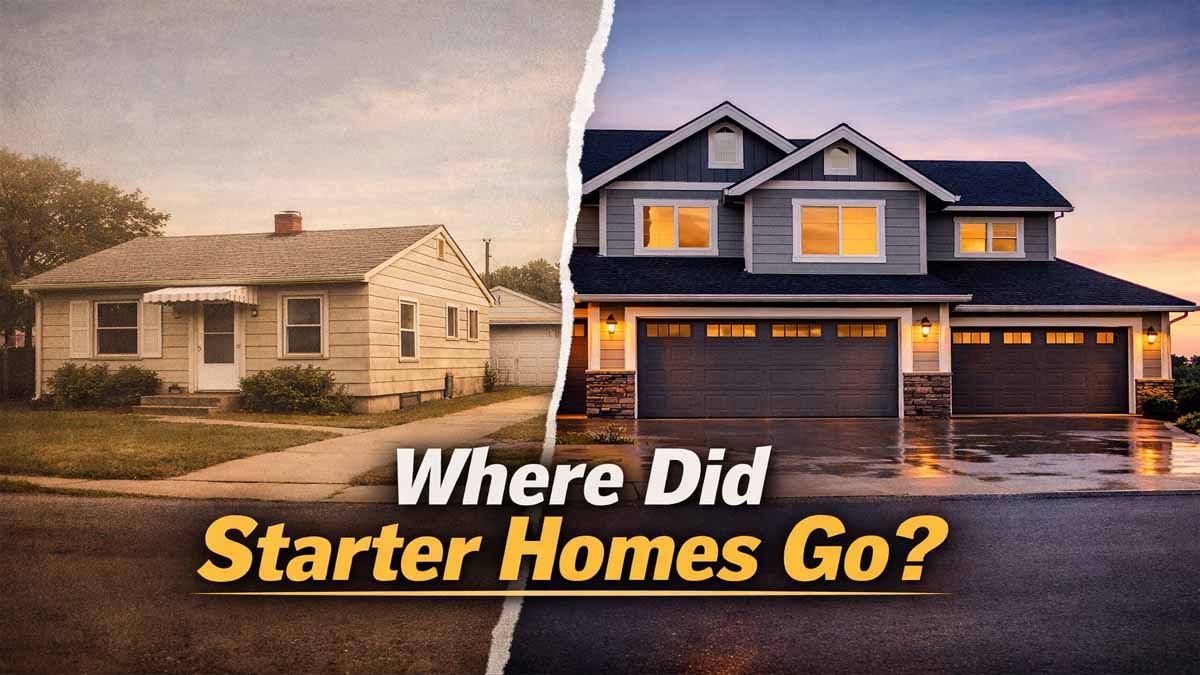
If you're looking for your first home in 2026, you've probably noticed something strange. The traditional "starter home" — that modest, detached house with a decent yard — has vanished from new construction. What happened? It's not just about prices.
The American housing market has undergone a structural shift that's changing what homeownership means. What you can buy today is fundamentally different from what your parents bought. This isn't temporary inflation; it's a complete system change.
Key Insight: The traditional starter home has become illegal to build in most areas due to zoning laws, and unprofitable for builders due to fixed costs. The market has completely reorganized around this reality.
What Exactly Disappeared?
The Post-War Dream House
From 1945 to 1980, starter homes were everywhere. Think about those classic ranch houses. They were typically 750-1,200 square feet on lots of 6,500-10,000 square feet.
The magic formula was simple: small house, big lot. This allowed for expansion later — finishing attics, adding garages, building extensions as families grew. The land provided both privacy and future value.
The "Bigger is Better" Shift
Starting in the 1990s, everything changed. Houses got bigger while lots got smaller. By 2020, the average new home was 2,484 square feet — 158% larger than in 1950.
Why? Builder economics changed. With rising land development costs, putting a small house on an expensive lot made no financial sense. Builders needed bigger homes to absorb those fixed costs.
| Feature | 1950s Starter Home | 2026 Entry-Level | What Changed |
|---|---|---|---|
| Living Area | 983-1,500 sq ft | 1,800-2,200 sq ft | Larger interior, higher utility costs |
| Lot Size | 8,000-10,000 sq ft | <7,000 sq ft | Lost outdoor space and privacy |
| Structure Type | Detached single-family | Townhouse / Zero-lot-line | More density, less privacy |
| Land Ownership | Fee simple (full control) | Fee simple (HOA restricted) | Reduced rights to modify property |
| Expansion Potential | High (room for additions) | Low/none (maxed out) | Can't grow with family |
The 3 Main Reasons Starter Homes Vanished
1. The Regulatory Stranglehold
Minimum Lot Size (MLS) regulations are the biggest culprit. In 90% of residential zones, it's illegal to build small homes on small lots. Many areas mandate 0.25 to 1-acre minimums.
These rules force land costs per home to skyrocket. When raw land costs $200,000 due to artificial scarcity, no builder will put a $150,000 starter home on it. They'll build luxury homes instead.
2. The Economics of Modern Building
Fixed costs are killing small homes. Permits, utility hookups, and infrastructure costs are the same whether you build 1,200 or 3,000 square feet.
If fixed costs are $150,000 per lot, building small yields tiny margins. Building big yields 22%+ margins. Builders rationally choose profitability over affordability.
3. Institutional Competition
Build-to-rent developers and REITs now compete for land. They have lower capital costs and can pay more, driving up prices and squeezing out starter home builders.
What Actually Replaced Starter Homes?
The Townhouse Revolution
Townhomes now account for 18.3% of single-family starts. They offer 10-18 units per acre versus 3-4 for detached homes. This reduces land costs enough to hit entry-level prices.
But you trade side yards and privacy. Mandatory HOAs and party-wall agreements add complexity. Still, it's the closest thing to traditional ownership left.
Build-to-Rent Communities
Institutional investors now build entire neighborhoods for renters. These mimic starter home communities but offer zero ownership. Tens of thousands of these units are delivered annually.
For many Americans, the "starter home experience" is now a rental agreement. You get the house but build no equity.
The Condo-ization of Everything
Even detached homes are often legally condos now. Buyers own the "air space" but not the land beneath it. Yards are common areas assigned for exclusive use.
This bypasses minimum lot size rules but fundamentally changes what you own.
Expert Checklist: What to Ask Before Buying
First-time buyers need to look beyond square footage. Here's what matters in 2026:
The Hidden Cost: Land Literacy Gap
Modern buyers focus on price-per-square-foot but ignore land value. Here's the problem: land typically appreciates, while structures depreciate.
Today's "entry-level" homes shift value from land to structure. You get more interior space but less appreciating asset. This affects long-term wealth building.
Common Mistake: Buyers celebrate getting 2,000 square feet for $350,000. They don't realize they're getting almost no land — the actual appreciating asset.
Frequently Asked Questions
Only as existing inventory, usually 40+ years old. New construction of small houses on big lots happens only in deep exurbs or rural areas, often with infrastructure costs that negate affordability.
They can be, but with different risk profiles. Townhomes may appreciate slower due to shared land ownership. High HOA fees also affect cash flow. Research the HOA's financial health before buying.
Homeowners in existing neighborhoods often resist density increases to protect property values. Changing zoning requires political will that's frequently lacking at local levels.
It depends on your goals. Renting offers flexibility but builds no equity. Buying builds equity but comes with maintenance responsibilities and less flexibility to move.
Focusing only on monthly payment and interior square footage. Successful buyers in 2026 understand land rights, zoning restrictions, and long-term property limitations before purchasing.
The Bottom Line
The American starter home as we knew it is gone. It's not coming back without major zoning reform and economic shifts.
Today's entry-level buyers face a different reality: more interior space, less land, and complex ownership structures. Success requires "land literacy" — understanding what you actually own and what rights you've traded away.
The housing ladder still exists, but the first rung looks completely different in 2026. Adapting to this new reality is the key to successful homeownership in modern America.